
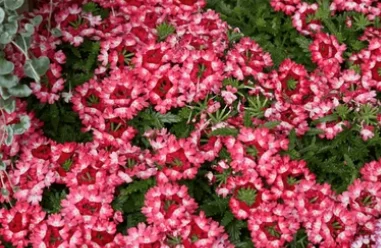
Description
Verbena flowers come in an array of cheerful hues including red, pink, apricot, lavender, purple, blue, white and bicolors. Clusters of small star-shaped flowers on mounding, trailing or upright plants are complemented by green lanced-shaped leaves with finely toothed edges.
Use verbenas in containers, hanging baskets, borders or mass plantings. Highly attractive to butterflies and other insect pollinators, this durable plant is tolerant of different soils, heat and drought. Most are grown as annuals, but some common types are hardy in USDA zones 7-11.
PLANTING & CARING FOR VERBENA
How to plant: Choose a site with good air circulation that receives at least 6-8 hours of full sun a day. Follow these steps and space 12-18” apart, depending on the variety.
- Loosen the soil in the planting area to a depth of 6-12”.
- Remove the plant from the nursery pot and loosen roots if potbound.
- Set plant in the hole with the top of the root ball level with the surrounding soil.
- Backfill the hole with soil and tamp down lightly to remove air pockets.
- Water regularly until plants are established.
Soil: Verbena thrives in soil amended with compost, but can adapt to many soil types as long as there is good drainage. Compacted or clay soil can lead to root rot.
Watering: Verbena does best in moderately moist soil, but can tolerate some drought. Too much water can result in root rot or mildew. Provide regular water and allow the soil to dry out between waterings. Irrigate more frequently during prolonged heat or dry spells.
Fertilizing: For best flowering, apply a slow-release all-purpose fertilizer according to instructions, or use a water-soluble fertilizer once a month during the growing season. Learn more in this guide to fertilizing annual plants.
Pruning: Deadhead spent flowers. Trailing and groundcover types can be trimmed back several times during the growing season to stimulate new growth and flowers. Cut back up to 1/4 of the stem length. Plants can be trimmed at any time if they outgrow their space.
VERBENA PLANT TYPES
Verbenas come in different types. Here are some of the most commonly grown:
Purpletop verbena (V. bonariensis), also known as tall verbena, is an upright form with purple flowers. Hardy in USDA zones 7-11, plants grow 3-6’ tall and 1-3’ wide. Highly attractive to butterflies and other pollinating insects, the open airy form makes this useful as a background or structural plant.
Garden verbena (V. x hybrida), with a mounding or trailing habit, is the type most commonly grown. Plants can reach 6-18” tall and 12-30” wide. Hardy in USDA zones 8-11, this tender perennial is most often treated as an annual. Dozens of varieties come in a range of flower colors. Popular for hanging baskets, window boxes, container gardens and landscape beds.
Tuberous verbena (V. rigida), also known as slender vervain, is heat and humidity tolerant, making it a great plant for the deep south. Plant in well-drained soils in full sun. This tender perennial is hardy in USDA zones 7-10, but can be grown as an annual in cooler climates.
** Assorted colors/varieties. Image for representation only. Plastic 4 Pack. **


Reviews
There are no reviews yet.